
AI in Agriculture: Practical Ways Farmers and Small Businesses Can Use Artificial Intelligence
May 21, 2026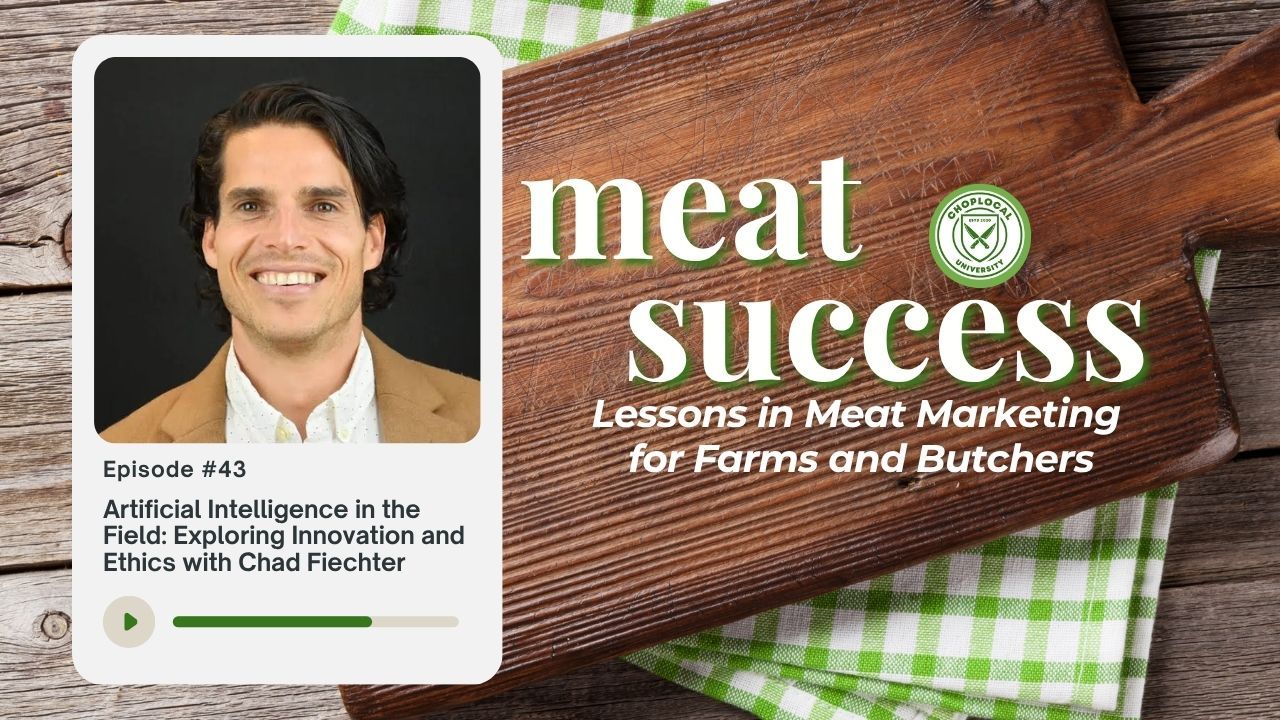
Artificial intelligence (AI) is no longer a futuristic concept, it’s becoming a practical tool for farms, meat businesses, and rural entrepreneurs looking to save time, make better decisions, and stay competitive.
In a recent episode of the Meat Success Podcast, we sat down with Chad Fiechter, associate professor in the Department of Agricultural Economics at Purdue University, to discuss what AI actually looks like in agriculture today and how producers and small business owners can start using it with confidence.
Their conversation explored everything from farm management and financial planning to data privacy and responsible content creation, offering a grounded perspective on one of the fastest-growing technologies impacting agriculture.
What Does Artificial Intelligence Mean for Agriculture?
When people in agriculture hear “AI,” the first reaction is sometimes a joke about artificial insemination. but artificial intelligence is quickly becoming a serious business conversation.
AI refers to technology that can analyze information, generate ideas, automate repetitive tasks, and assist with decision-making. While AI has existed in various forms for decades, recent advances have made these tools far more accessible to farms and small businesses.
For Chad Fiechter, that accessibility changed his own perspective.
After transitioning from full-time farming into academia, he admitted he was initially skeptical about emerging technologies. But as AI capabilities evolved, he began incorporating them into farm operations, student projects, and professional workflows to uncover efficiencies and solve problems more effectively.
Today, AI in agriculture isn’t about replacing producers, it’s about helping them make faster, more informed decisions.
How Farms and Small Businesses Are Using AI Today
One of the most valuable takeaways from the conversation was that AI adoption doesn’t have to be complicated. Many agricultural businesses are already using AI without building custom software or hiring technical teams. Common applications include:
- Creating and organizing business plans
- Summarizing financial information
- Generating marketing content and social media ideas
- Drafting grant applications and reports
- Developing workflows and operating procedures
- Brainstorming solutions for operational challenges
- Building custom spreadsheets or lightweight tools
- Supporting customer communication and outreach
Chad described AI as a thought partner rather than a replacement for expertise.
That distinction matters. AI can provide options, generate ideas, and surface patterns, but producers still bring the real-world experience and context needed to make strong decisions.
Using AI as a Decision-Making Tool in Farm Management
For many producers and meat business owners, time is one of the most limited resources. Between managing livestock, overseeing employees, maintaining compliance, handling finances, and marketing products, there’s constant pressure to become an expert in dozens of areas.
This is where AI can become a practical advantage. Instead of spending hours researching unfamiliar topics, producers can use AI tools to:
- Ask questions in plain language
- Explore multiple approaches to a challenge
- Pressure-test business decisions
- Generate first drafts of plans or messaging
- Learn unfamiliar concepts quickly
Chad encouraged users to think beyond one-time prompts and instead engage AI in conversation.
The strongest results often come through iteration:
- Ask follow-up questions
- Challenge assumptions
- Request alternative viewpoints
- Compare responses across platforms
- Refine outputs until they align with business goals
This approach transforms AI from a search tool into a collaborative assistant.
AI Data Privacy: What Agricultural Businesses Should Know
One of the biggest concerns surrounding AI adoption is information security.
Farm financial records, operational data, customer information, and proprietary business insights are sensitive assets and business owners should treat them carefully. Chad emphasized a practical approach to AI privacy as the following:
Read Platform Privacy Policies
Before uploading sensitive documents, understand how a platform stores and uses data.
Consider Paid Versions
Subscription plans often offer stronger privacy protections and greater control over data usage.
Avoid Uploading Sensitive Information Unnecessarily
Whenever possible, remove identifying details or summarize information rather than sharing complete records.
Ask Questions About Data Policies
AI platforms often provide transparency around how information is handled—use that information before integrating tools into business workflows.
Being intentional about privacy helps businesses adopt AI responsibly without exposing critical information.
How to Maintain Quality When Using AI-Generated Content
Another important topic from the conversation centered on accountability. AI can generate content quickly but speed doesn’t replace responsibility. Whether creating marketing copy, educational materials, grant applications, or internal documents, business owners still own the final output.
Chad shared a simple principle: verify what AI produces. That means:
- Reviewing facts and claims
- Checking citations and sources
- Editing for brand voice
- Confirming recommendations fit your operation
- Reading referenced materials directly
For agricultural businesses built on trust and reputation, maintaining quality standards matters as much as efficiency.
Why AI Could Become Agriculture’s Most Accessible Learning Tool
Agriculture demands broad expertise. Producers are expected to understand production, finance, labor management, compliance, sales, technology, and marketing, all while running day-to-day operations.
AI has the potential to lower the barrier to learning. Instead of waiting for formal training or searching across dozens of resources, business owners can access immediate guidance and educational support.
That doesn’t replace industry expertise or professional advice, but it can make learning more accessible and accelerate growth. For meat businesses and agricultural entrepreneurs, that advantage may become increasingly important.
Final Thoughts: AI Won’t Replace Agricultural Expertise But It Can Expand It
This conversation with Chad Fiechter highlights an important reality: AI in agriculture isn’t about replacing producers, processors, or rural entrepreneurs. It’s about creating leverage.
When used thoughtfully, AI can help farms and small businesses streamline operations, strengthen decision-making, improve education, and create more capacity to focus on the work that matters most.
The businesses that benefit most likely won’t be the ones using AI to do everything, they’ll be the ones using it strategically.
Listen to the full episode of the Meat Success Podcast for more insights on adopting AI in agriculture and building smarter, more resilient businesses.
Stay connected with news and updates!
Join our email list for the latest tools and tips to help you sell more meat online!
Don't worry, your information will not be shared.
We hate SPAM. We will never sell your information, for any reason.
